Businesses invest in Customer Relationship Management (CRM) software because of its potential to deliver cleaner reporting, stronger sales performance and better visibility across customer relationships. However, realising those results depends on a successful implementation. If implementation is poor, then customer data remains inconsistent, reporting is unreliable and efficiency gains are left on the table.
A CRM consultant specialises in avoiding these implementation risks, tailoring systems to your operational needs and ensuring you enjoy the maximum return from your CRM investment. Whether your organisation is selecting its first platform or trying to improve an underperforming system, this guide explains how professional CRM guidance can streamline implementation and maximise results.
What Does a CRM Consultant Do?
A CRM consultant uses their specialised expertise and experience to help businesses with:
- Strategic CRM planning: A CRM consultant reviews your existing workflows, customer journey and operational bottlenecks to clarify what the CRM should achieve. This helps to avoid unnecessary complexity and implement with results in mind.
- CRM selection: The consultant helps businesses choose a CRM platform based on operational fit, scalability, integrations, reporting needs and ease of use. This can reduce the risk of selecting systems that are unnecessarily complex or too limited to support future growth.
- CRM customisation: CRM consultants configure sales pipelines, dashboards, permissions and workflows to support how teams actually operate day to day. Thoughtful setup improves adoption and saves time by reducing inconsistent data entry and encouraging teams to work within the CRM rather than siloed spreadsheets.
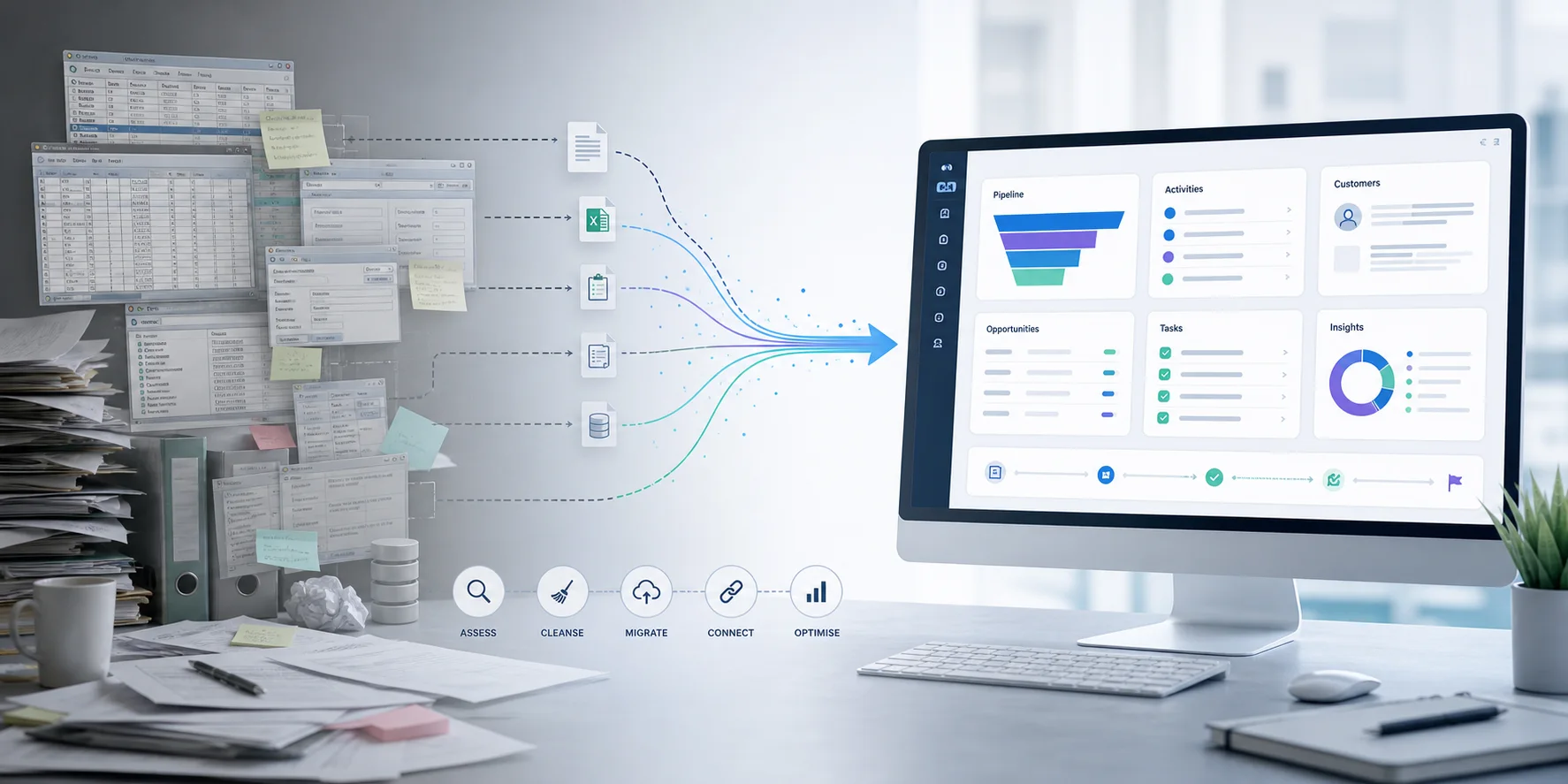
- Data migration and integrations: Consultants help businesses organise customer data before migration to minimise duplicate records and reporting issues while improving cross-department collaboration. Depending on project scope, they may also support integrations between the CRM and systems like email platforms, Enterprise Resource Planning (ERP) software, marketing tools and other applications.
- Training and adoption: Consultants train teams to use the CRM in real workflows, including updating deals, logging activity and tracking customer interactions. Role-based onboarding and clear usage rules improve consistent, long-term system adoption.
- Ongoing optimisation: As businesses evolve, CRM systems often require ongoing refinement to stay aligned with changing workflows, reporting requirements and administrative responsibilities. While 91% of businesses with 10+ employees use a CRM system, needs shift as companies grow or update operations. Consultants help improve processes over time and maintain efficiency as operational needs change.
Benefits of Hiring a CRM Consultant
While an experienced CRM consultant brings strong expertise in strategy, implementation and optimisation, the results they deliver are what ultimately justify the investment. Hiring an expert CRM consultant can deliver tangible benefits in several key areas.
Superior ROI
The ROI of hiring a CRM consultant comes mainly from reducing wasted effort during implementation and ensuring the system is adopted properly from the start. A properly implemented CRM avoids repeated redesigns of workflows, data structures and reporting logic by getting these decisions right early. This means less time spent fixing issues like duplicate data, inconsistent sales pipelines or unreliable reporting once the system is live.
ROI also comes from faster adoption and more consistent usage across teams. When data is structured correctly and used consistently, reporting becomes more reliable, improving forecasting and decision-making.
Faster Implementation
UK businesses implementing CRM internally often spend significant time learning platform capabilities while redesigning operational processes to fit the new system. This can slow progress, waste time on non-core functions and create uncertainty around configuration decisions.
An experienced consultant can help prioritise the most valuable functionalities first, avoid delays caused by unclear requirements and yield faster time to value.
Better Strategic Alignment
CRM systems perform best when they reflect how the business actually operates rather than forcing teams into new processes that don’t fit. A consultant helps you think through how sales, customer service, marketing and operations interact, so they can build CRM workflows that really work for your business.
This often improves consistency between departments and reduces the silos that can emerge when teams manage customer information differently. The result is better visibility and decision-making.
Reduced Implementation Risk
Many CRM problems emerge months after implementation rather than during initial setup. Reporting inconsistencies, duplicate data, confusing workflows, inconsistent adoption and under-informed decisions often become more difficult to correct once employees are already using the system.
A CRM consultant can help businesses reduce these risks by introducing more structured planning, forward-looking implementation and clearer governance processes from the beginning. This often makes future optimisation easier and reduces the likelihood of costly rebuilds later.
Better Adoption
Employees are more likely to engage with CRM systems when processes are practical, reporting is intuitive and administration is efficient. Poor adoption is often linked more to workflow complexity and inconsistent implementation than software selection.
Consultants help businesses simplify workflows, offer role-based onboarding and structure training more effectively. This can shift team perspectives from seeing CRM as an administrative burden to recognising it as a useful tool that makes everyday work more seamless.
Improved Reporting and Visibility
The usefulness of your company’s reporting depends on data consistency and process clarity. If teams use the CRM differently or skip key stages in workflows, management reporting quickly becomes unreliable.
A CRM consultant helps businesses standardise how information is handled across departments. This can improve forecasting visibility, customer tracking, pipeline management and operational decision-making.
Long-Term CRM Scalability
As organisations grow, CRM requirements often become more complex. New departments, more users, evolving reporting needs and increased automation can place pressure on systems that were configured for simpler workflows.
A forward-looking consultant helps businesses introduce scalable structures early so the CRM remains manageable as operational complexity increases. This may involve improving permissions, simplifying workflows, refining reporting standards or introducing more structured governance processes.
Self-Implementation vs. CRM Implementation Partner: A Side-by-Side Comparison
| Self-Implementation | CRM Implementation Partner | |
|---|---|---|
| Initial setup speed | Internal teams often learn the platform while redesigning processes at the same time, slowing implementation. | Structured implementation frameworks help businesses launch faster with clearer priorities. |
| Workflow design | CRM processes may be built around software defaults rather than operational reality. | Workflows are designed around how sales, marketing and operations actually function. |
| Reporting accuracy | Inconsistent data entry and pipeline usage can make forecasting unreliable. | Standardised processes improve reporting consistency and decision-making visibility. |
| Data quality | Duplicate records, incomplete fields and inconsistent customer histories often accumulate over time. | Data structures and migration processes are planned to improve long-term accuracy. |
| Team adoption | Employees may develop inconsistent habits or avoid using the CRM entirely. | Role-based onboarding and governance improve long-term adoption and accountability. |
| Integrations | Systems are often connected reactively as problems emerge later. | Integrations are planned upfront to support smoother cross-department workflows. |
| Scalability | CRM structures that work for small teams can become difficult to manage as operational complexity increases. | Systems are configured with future reporting, automation and user growth in mind. |
| Long-term experience | Businesses often discover reporting issues, workflow inefficiencies, admin overload and poor adoption 6-12 months after launch. | Structured implementation reduces the likelihood of costly rebuilds and operational friction later. |
CRM Consultant vs. Self-Implementation FAQs
Why not self-implement CRM for my business?
Self-implementation is not recommended, because an experienced CRM consultant’s support can reduce risks and deliver superior ROI. Common issues include poor data structure, inconsistent pipelines, unclear user roles and reporting misalignment. These problems often lead to low adoption and unreliable decision-making, reducing the overall value of the CRM system.
Which businesses benefit most from hiring a CRM implementation partner?
The businesses that often benefit most from hiring a CRM consultant or implementation partner include:
- Growing companies with more complex workflows
- Teams still relying heavily on spreadsheets
- Businesses implementing CRM for the first time
- Organisations struggling with low CRM adoption
- Companies with disconnected systems or unreliable reporting
- Teams without dedicated internal CRM expertise
Is hiring a CRM consultant worth it for small businesses?
Yes, hiring a CRM consultant is a worthwhile investment for many small businesses. A consultant can help ensure your CRM is set up effectively for your needs while avoiding common implementation mistakes that leaders without deep CRM expertise make. This can be particularly valuable for organisations moving away from spreadsheets or introducing more structured sales and reporting processes for the first time. Skilled CRM consultants excel at scalable thinking and can ensure your CRM is implemented to grow with your business.
Simplify Implementation With CRM Insights
CRM Insights is a CRM consulting and implementation firm based in Peterborough, serving businesses across Cambridgeshire and the UK. As an independent CRM consultancy, we design systems around your business processes rather than a specific platform or predefined setup.
We specialise in helping organisations move away from spreadsheet-based or fragmented systems into structured CRM environments that improve efficiency, reduce manual work and improve reporting reliability. Whether you are evaluating CRM platforms, struggling with adoption or improving an existing system, our team can help build and implement a CRM solution that works for you.
Schedule your free consultation today to get a practical assessment of current CRM needs and clear recommendations for maximising ROI.